
Florida-based. On site at your plant or in an R&D lab.
Extrusion FAQ
Common questions about extrusion processes and equipment, organised by market, by region and by the job of the person asking. If yours is not here, ask it directly.
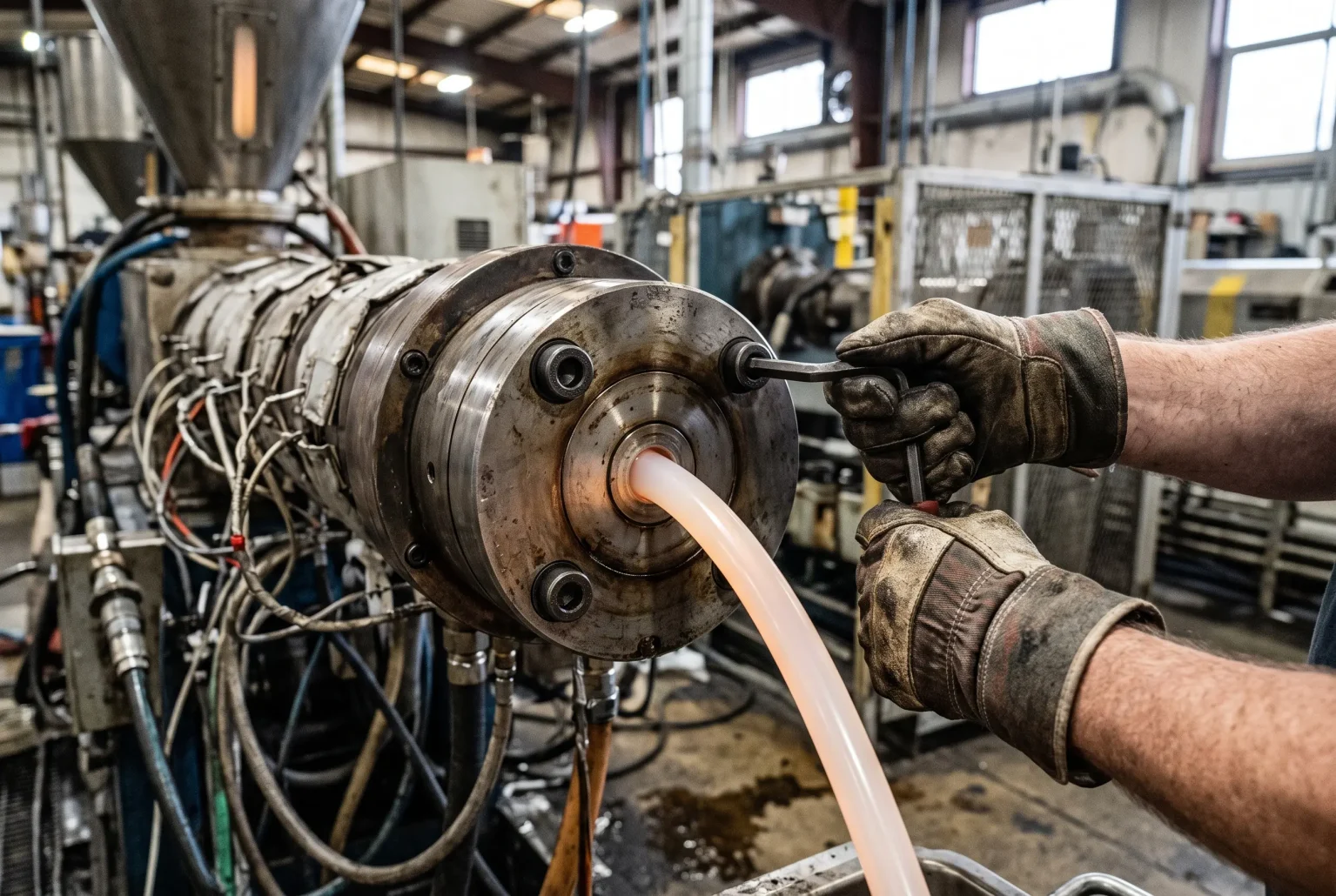
The questions that come up on almost every line, whatever it makes.
Most surging starts with solids conveying in the feed section, not at the die. Check the feed throat temperature and screw cooling first: a hot feed casing lets pellets soften and stick. Then look at feed consistency, the proportion of regrind, screw and barrel wear, and the drive. A gear pump can smooth output, but it will not cure a badly surging extruder.
Because most of the heat in the melt comes from the screw working the material, not from the barrel heaters. Screw design, the resin and head pressure set melt temperature more than the barrel zones do. Measure the melt itself before changing setpoints.
The usual signs are falling output at the same screw speed, rising melt temperature, black specks and surging. One common rule of thumb puts the cut-off for replacing a screw at a flight clearance of about four times the original tolerance, depending on the resin.
It depends on the resin. Moisture-sensitive materials such as nylon and PET are the most demanding. Desiccant dryers can achieve a dew point of about minus 40 degrees Fahrenheit, which is considered adequate for hygroscopic resins. Drying also takes time at temperature, so follow the material supplier’s residence time and check that the dryer is really delivering it.
L/D is the length of the screw divided by its diameter. Around 24:1 is the most common, with 30:1 or more on some machines. Compression ratio compares the channel depth in the feed section with that in the metering section and is usually between two and four. Both are chosen for the material and the output needed.
A gear pump meters the melt and takes over pressure building from the screw, which steadies output and can lower melt temperature. It makes most sense where dimensional tolerance is tight or where a steadier wall saves enough material to pay for it. It is not a fix for a screw or feed problem.
Purge until the material coming out is clean, not to a fixed weight, and seal the barrel with a heat-stable compound for shutdowns. Then write the routine down. Purge practice that differs by shift is a common source of contamination and start-up scrap.
Track it separately from running scrap so that you can see it. Standardise the start-up sequence and the settings that work, and have every shift use them. Much start-up scrap is the cost of each crew finding its own way to a running line.
For tubing: sizing and a cooling tank, wall and diameter gauges, a puller and a cutter or coiler. For wire and cable: conductor payoff and preheat, a cooling trough, a capstan, diameter and concentricity gauges, a spark tester and a take-up. Downstream equipment decides quality as much as the extruder does.
A few of the most common questions in each market. Each market page has the full set, with fault tables and standards.
Usually moisture in the compound, water or contamination on the conductor, or insulation that has drifted off centre and left a thin wall. Check drying and material handling first, then conductor preparation, then concentricity.
Pressure tooling brings melt and conductor together inside the die for intimate contact. Tubing tooling draws a tube down onto the core outside the die, which is typical for jacketing. The construction, the material and the line speed decide.
Stress frozen into the insulation: a cold conductor, quenching too cold or too close to the die, too much draw-down or too much tension.
It depends on size, material and method. About a thousandth of an inch is commonly discussed for small tubing. A capability run on your own line gives the real answer.
Air pressure, puller speed and water temperature act together. A small change in any one moves the outside diameter, the lumens and the walls between them.
Since February 2, 2026, 21 CFR Part 820 incorporates ISO 13485:2016 by reference. For a tubing supplier the practical requirement is a controlled, documented process and trained people.
Several extruders feed one head: typically a polyamide outer layer, a barrier layer and a conductive inner layer, with tie layers where materials would not otherwise bond.
A die that is not centred, unbalanced flow, surging or uneven cooling. Variation around the circumference points to tooling. Variation along the length points to the extruder, puller or cooling.
SAE J2260 for fuel tubing, SAE J844 for air brake tubing, the customer’s own specification and IATF 16949 for the quality system.
Viscosity mismatch between materials, a difference in melt temperature between streams, or flow that is not balanced in the head.
When two materials that do not bond have to stay together. A thin layer that adheres to both is extruded between them.
If a wire, core or substrate passes through the head, a crosshead. Otherwise either can work, and both are built in multilayer versions.
GBET is based in Florida and works on site. The regions page has figures for each part of the world.
Yes. The work is done on site at customer plants, or in an R&D lab where that suits the project better.
Gene has worked in plants abroad as well as across the United States. Tell us where the line is, what it makes and what language your crews work in.
With due diligence and equipment selection, then training that begins before the line is commissioned, so that operators are ready when it starts.
Not to the fundamentals. Dimensions, materials and tests differ, and those feed into tooling selection and process settings.
In English. If your crews work in another language, say so at the start so that an interpreter or bilingual lead can be part of the sessions.
The same line looks different depending on where you stand.
Start with what the line loses today: scrap in start-ups and changeovers, hours of unplanned downtime and the rework both cause. In extrusion, material is usually the largest cost in the product, so scrap is paid for at full price. A before-and-after measure of those few numbers is the business case.
Scrap by cause (start-up, changeover and running), downtime hours and their reasons, and output per hour by product. Even rough numbers show where to look first.
Yes. Flow analysis is part of GBET’s die design work, used to check balance and residence in the tooling before a design is released or a die is modified.
Yes. Die design improvements are a regular request: land lengths, die gap, tip and die geometry and flow balance.
Build training around how your best people actually run the line, then write the set-ups and routines down so that they outlast any one person. Training is one-on-one and hands-on for that reason.
If you need a record of what each person covered for your own training files, say so when the programme is scoped. GBET training is practical instruction, not a credential from an accrediting body.
A clear product, the right equipment for it and people who can run it. Due diligence covers what the product standard requires, which extruders, tooling and downstream equipment are needed, and what realistic output and scrap look like.
Before the specification is fixed. Changing a screw design or a tooling choice on paper costs far less than changing it after installation.
Hands-on extrusion training, consulting on processes and equipment selection, help with vendor selection and purchasing negotiations, on-site project management, die design, flow analysis, troubleshooting and product development.
With a conversation about what you need, what your limits are and what success looks like. The scope is then defined, remotely or at your facility.
Operating parameters, the material data sheet, and screw and tooling information for the line in question, plus a description of the product and the problem.
Yes. Drawings, specifications and process details are treated as confidential, and GBET will work under your non-disclosure agreement.
Further reading: Plastics Technology: troubleshooting flow surging; Plastics Technology: the role barrel temperatures play in melting; Plastics Technology: screw wear; Plastics Technology: resin dryers; Allan Griff, PlasticsToday: the taming of the screw; Plastics Technology: is a gear pump right for your operation; Plastics Technology: purging.
Tell us what the line is doing, what it should be doing, and what cannot change. You will get a plain answer on whether training, tooling, equipment or process work is the right place to start.
We use cookies to improve your experience on our site. By using our site, you consent to cookies.
Manage your cookie preferences below:
Essential cookies enable basic functions and are necessary for the proper function of the website.
You can find more information in our Cookie Policy.