
Florida-based. On site at your plant or in an R&D lab.
Markets
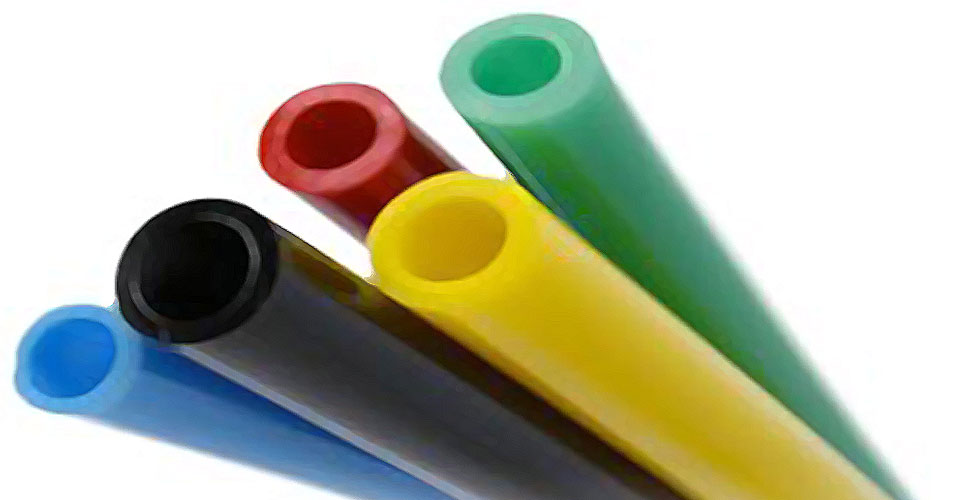
Tubing for fuel, fluid, air and industrial service, and the sheathing of hose and other substrates. Much of it is now multilayer, and all of it has to hold its dimensions at speed.
$16.6B
global automotive hoses market in 2025
5.1%
forecast annual growth, 2026 to 2031
20M+
electric cars sold worldwide in 2025, a quarter of all new cars
83 kg
of copper in a battery electric car, against 23 kg in a conventional one
Fuel lines are typically multilayer: a polyamide outer layer, a barrier layer to hold back fuel vapour and often a conductive inner layer to carry away static charge. Electric vehicles add thermal management lines for batteries and power electronics, where plastic tubing takes weight out by replacing rubber and metal.
On the industrial side, pneumatic, fluid-handling and protective tubing needs what it always has: consistent dimensions, a clean surface and a line that keeps running.
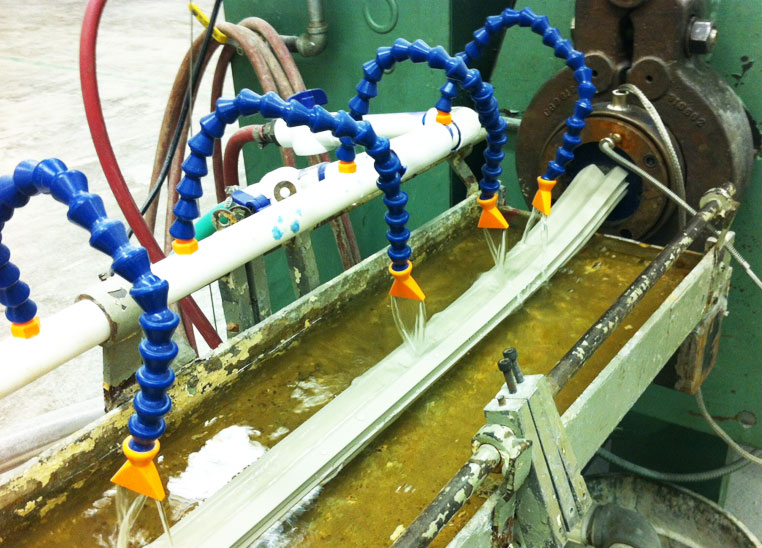
Tubing problems tend to show up downstream and start upstream.
| Symptom | Common causes | Where to look first |
|---|---|---|
| Wall thickness variation | Die not centred, unbalanced flow in the head, surging, uneven cooling | Tooling centring and condition, feed and screw, first section of the tank |
| Ovality or flat spots | Sizing or vacuum problems, uneven cooling, puller pressure, coiling while the tube is still warm | Calibrator and tank set-up, puller, take-up |
| Layers delaminating | Materials that do not bond and have no tie layer, temperature too low where the layers join, contamination or moisture | Material pairing and tie layer choice, head temperatures, drying |
| Uneven layer distribution | Viscosity mismatch between materials, melt temperature differences, head design | Melt temperature of each extruder, tooling |
| Poor adhesion when sheathing | Substrate temperature or cleanliness, vacuum, pressure or tubing tooling chosen wrongly for the job | Substrate preparation, vacuum, tooling type |
| Surface defects | Moisture, melt fracture, build-up at the die | Drying, die temperature, output rate |
Hands-on training for operators and technicians on mono-wall, multilayer and sheathing lines.
Bringing layers on in the right order and at the right rates, and finding out why a layer has moved.
Crosshead and die design for sheathing and multilayer products, with flow analysis where it helps.
Equipment and vendor selection, and project management through installation and start-up.
Named here for orientation. Your customer’s specification decides which ones apply.
| Standard | What it covers |
|---|---|
| SAE J2260 | Nonmetallic fuel system tubing with one or more layers |
| SAE J844 | Nonmetallic air brake system tubing |
| SAE J1645 | Electrostatic charge mitigation in fuel systems and components |
| IATF 16949 | The automotive quality management system standard, built on ISO 9001 and required through much of the supply chain |
Straight answers to the questions that come up most in this market.
Several extruders feed one head. A typical fuel line has a polyamide outer layer for mechanical strength, a barrier layer to limit permeation and a conductive inner layer for static discharge, with tie layers wherever two materials would not otherwise bond. All layers are formed in a single pass, then sized, cooled and gauged.
When two layers that do not bond to each other have to stay together. A thin layer of a material that adheres to both is extruded between them. Without it, dissimilar polymers can delaminate.
Sometimes. It depends on the space for additional extruders, the head and the downstream equipment. GBET can evaluate the line you have and tell you what would need to change.
Yes. Sheathing of various substrates is part of GBET’s experience, including the choice between pressure and tubing tooling and the substrate preparation that decides adhesion.
A die that is not centred, unbalanced flow in the head, surging from the extruder or uneven cooling. Start by checking whether the variation is around the circumference or along the length: the first points to tooling, the second to the extruder, puller or cooling.
For automotive tubing, usually an SAE product standard such as J2260 for fuel tubing or J844 for air brake tubing, the customer’s own specification, and IATF 16949 for the quality system. GBET works on the process that makes conforming product. Certification stays with you.
Service
Hands-on training on your tubing lines.
Learn more
Service
Line evaluation, equipment and vendor selection.
Learn more
Market
Two to five layers in a single pass.
Learn more
Further reading and sources: PlasticsToday: multilayer polyamide system for conductive fuel lines; Evonik: coolant lines; SAE J2260; SAE J844.
Tell us what the line is doing, what it should be doing, and what cannot change. You will get a plain answer on whether training, tooling, equipment or process work is the right place to start.
We use cookies to improve your experience on our site. By using our site, you consent to cookies.
Manage your cookie preferences below:
Essential cookies enable basic functions and are necessary for the proper function of the website.
You can find more information in our Cookie Policy.