
Florida-based. On site at your plant or in an R&D lab.
Markets
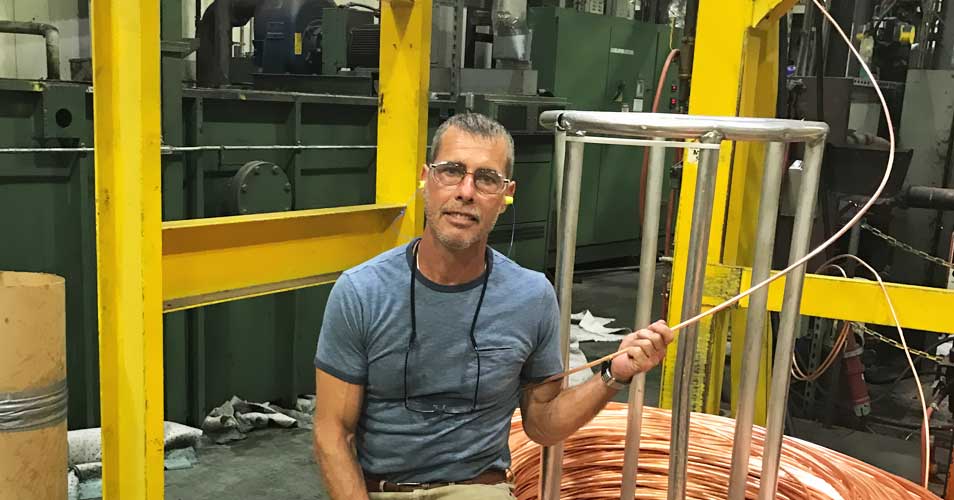
Insulating and jacketing lines run fast, run long and punish small mistakes. Gene Brown started on the floor of a building wire plant in 1979 and has worked on wire and cable processes ever since.
$230.9B
global wires and cables market in 2025
3.8%
forecast annual growth, 2026 to 2033
37.8%
of the 2025 market is in Asia Pacific
~$550B
grid investment the IEA expects worldwide in 2026
A building wire line can run at more than a thousand feet a minute, and the cardinal rule on the floor is that the line does not stop. At that speed a tip that is slightly off centre, a conductor that is too cold or a die that is the wrong size turns into scrap by the reel.
Demand is not the problem. Grids are being rebuilt, data centres are being wired and vehicles carry more cable every year. Capacity that runs right is the problem, and that comes down to tooling, equipment condition, materials and people.
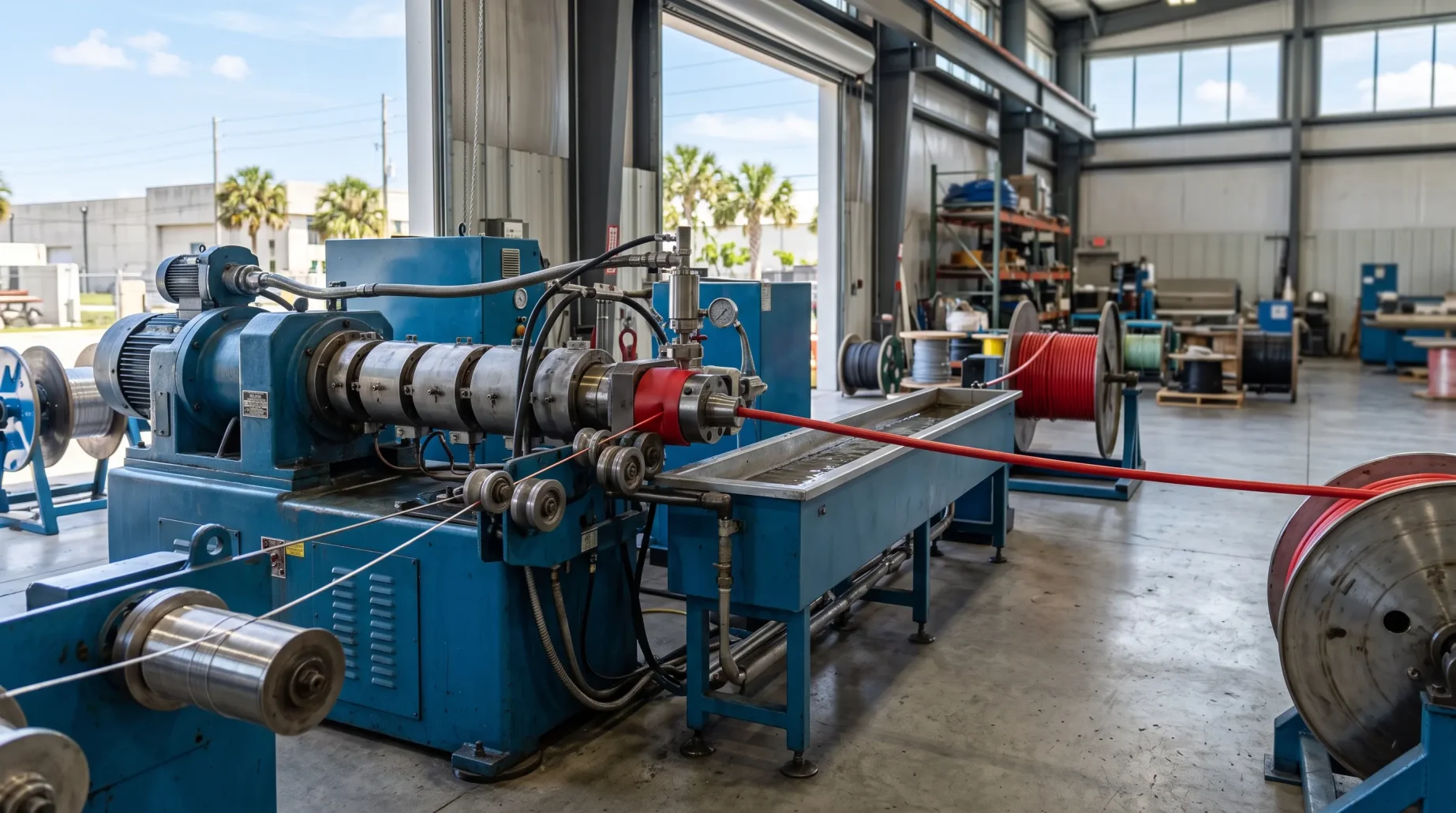
Every plant sees these. What differs is how quickly the crew gets from the symptom to the cause.
| Symptom | Common causes | Where to look first |
|---|---|---|
| Spark tester faults | Pinholes and bare spots, moisture in the compound, water or contamination carried on the conductor, off-centre insulation leaving a thin wall | Drying and material handling, conductor wipe and preheat, concentricity at the tooling |
| Eccentric insulation | Tip and die out of adjustment or worn, unbalanced flow in the head, unstable melt flow at high line speed | Tooling condition and centring, head and tip design, melt temperature |
| Diameter variation | Wrong die size, uneven die temperature, poor cooling, low melt strength, unstable feed at the hopper | Feed section and screw, capstan and line tension, temperature control |
| Lumps | Unmelted compound, scorched material, contamination | Screen pack, temperature profile, purge and shutdown practice |
| Rough surface | Melt temperature too low, die design or alignment, screen pack problems, melt fracture from high shear stress at the die | Die temperature and die gap, output rate, tooling design |
| Shrinkback | Conductor preheat too low, quenching too cold or too close to the die, too much draw-down, line tension, dirty conductor | Preheater, cooling trough layout and water temperature, draw-down ratio |
Hands-on training on insulating and jacketing lines, from start-up and tooling set-up to reading the spark tester and the gauges.
Working from the symptom to the cause, across materials, tooling, equipment condition and operating practice.
Tip and die selection, flow analysis and prototype runs for new constructions.
Due diligence, equipment and vendor selection, and project management through start-up.
Which standards apply depends on the product and where it is sold. GBET works on the process that has to meet them. Certification and listing stay with you and your test laboratory.
| Body | What it covers |
|---|---|
| UL | Product safety standards and listings for wire and cable sold in the United States, such as UL 83 for thermoplastic-insulated wire |
| NEC (NFPA 70) | The US installation code, which decides which wire types may be used where |
| CSA | Canadian product standards and certification |
| ICEA | Insulated Cable Engineers Association standards for cable construction and testing, often published jointly with NEMA |
| ASTM | Conductor and material specifications and test methods |
| IEC | International standards used across Europe, Asia and most export markets |
Straight answers to the questions that come up most in this market.
A spark tester applies high voltage to the insulated wire and flags any point where the insulation does not hold, such as a pinhole or a bare spot. Repeated faults usually come from moisture in the compound, water or contamination on the conductor, or insulation that has drifted off centre and left a thin wall. Check drying and material handling first, then conductor preparation, then concentricity. Gene has written about this in Extrusion Woes 101: Sparker Blows.
Sometimes. If the tip and die are out of adjustment or worn, centring or replacing them solves it. If the flow inside the head is unbalanced or the melt is unstable at your line speed, a change in melt temperature or die size may fix it before new tooling is needed. Off-centre insulation costs money twice: extra material to hold the minimum wall, and rejects downstream.
With pressure tooling the melt meets the conductor inside the die, under pressure, which gives intimate contact. With tubing tooling a tube of melt is drawn down onto the core outside the die, often with vacuum, which is typical for jacketing. The right choice depends on the construction, the material and the line speed.
Shrinkback is stress frozen into the insulation. The usual causes are a conductor that is too cold, quenching that is too cold or too close to the die, too much draw-down and excess line tension. Raising conductor preheat and cooling in stages are the common remedies.
That depends on the product and the market: UL and the National Electrical Code in the United States, CSA in Canada and IEC standards in most export markets, with ICEA and ASTM documents referenced along the way. GBET helps you run a process that makes conforming product. Certification and listing are handled with your test laboratory.
With due diligence. Several first-time customers have asked GBET for exactly this: what the target products require, which extruders, tooling and downstream equipment they need, what realistic output and scrap look like, and which vendors to talk to. After that come equipment selection, purchasing and project management through start-up.
Yes. Recent work includes a multilayer construction finished with a fluoropolymer jacket, and fine-wire prototypes with thin fluoropolymer walls.
Tell us what the line is doing, what it should be doing, and what cannot change. You will get a plain answer on whether training, tooling, equipment or process work is the right place to start.
We use cookies to improve your experience on our site. By using our site, you consent to cookies.
Manage your cookie preferences below:
Essential cookies enable basic functions and are necessary for the proper function of the website.
You can find more information in our Cookie Policy.